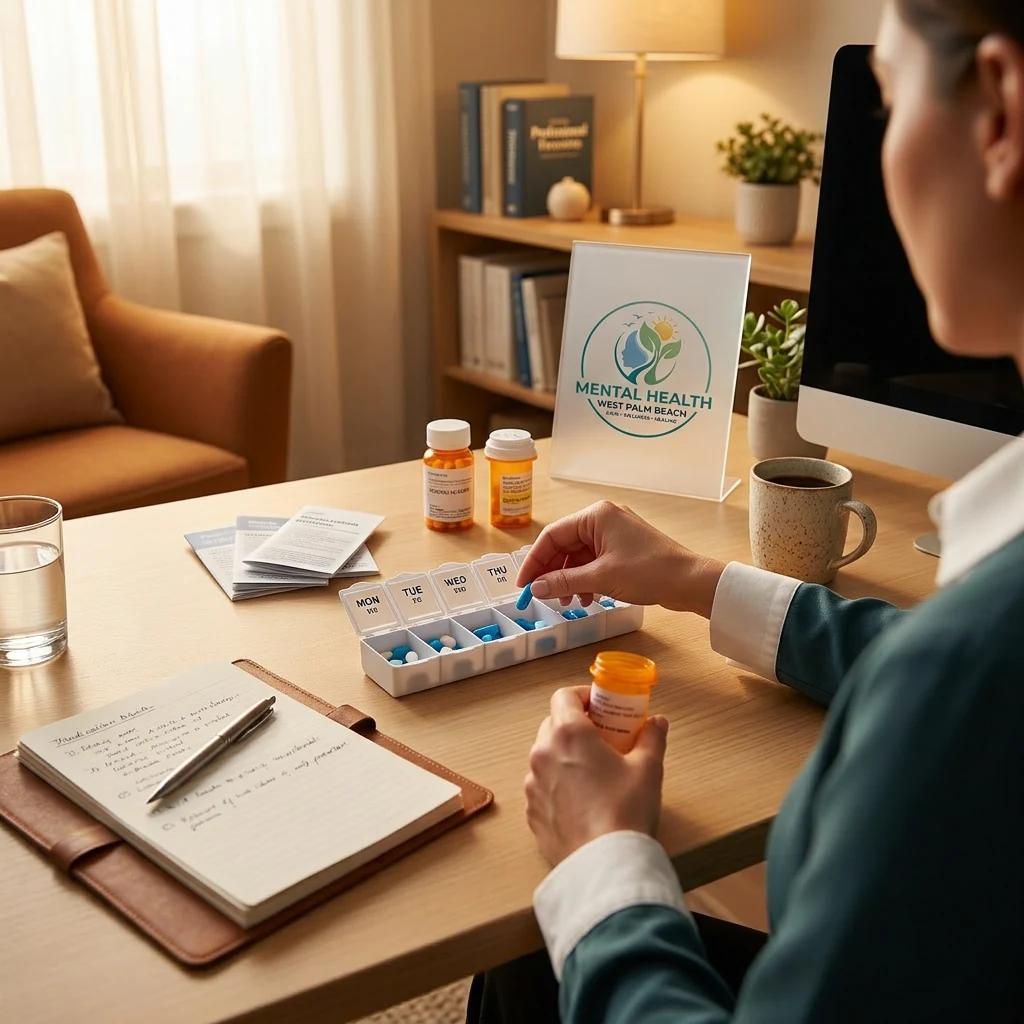
Is Adderall Addictive If You Have ADHD?
Reviewed by Josie Desmarais, PMHNP-BC · Board-Certified Psychiatric-Mental Health Nurse Practitioner · Last updated August 2026
Stimulants are safest within a monitored ADHD treatment plan led by a psychiatric prescriber.
Short answer: Substance use disorders are treatable medical conditions. A psychiatric evaluation can clarify the right level of care and connect you to evidence-based treatment.
Adderall is a Schedule II controlled substance with documented abuse potential. The more useful clinical question for adults with ADHD: when Adderall is prescribed at appropriate doses for a properly diagnosed condition, the addiction risk in the ADHD-diagnosed population is meaningfully lower than in the general population taking stimulants without ADHD. Large longitudinal studies show adults treated for ADHD with stimulant medication often have lower rates of substance use disorders than adults with untreated ADHD. That’s the evidence base, and it should inform the treatment plan.
This article walks through the pharmacology, the addiction risk data, the risk factors that matter, and the safety monitoring Trust Psychiatry – Mental Health West Palm Beach uses for adult patients on stimulant medication. For more on this, see our guide to how an NP can diagnose ADHD and prescribe Adderall.
Can People With ADHD Get Addicted to Adderall?
Yes — it is possible. Risk depends on patient profile, prescribing pattern, and how the medication is used. The clinical evidence breaks down into distinct findings:
Properly treated ADHD lowers substance use disorder risk overall. Adults with ADHD treated with stimulant medication show lower rates of subsequent substance use disorders than adults with untreated ADHD. Untreated ADHD itself drives self-medication with alcohol, cannabis, and stimulants — effective treatment reduces that pressure.
Misuse is distinct from therapeutic use. Adderall is misused in college and workplace populations as a study or productivity aid, often by people without ADHD. That misuse pattern produces a different risk profile than supervised therapeutic prescribing.
Personal and family substance use history matters. Adults with personal or family history of substance use disorder, or active recreational substance use, have elevated risk on stimulant medication. This is why the prescribing decision involves a substance use history at intake.
Dose and formulation matter. Long-acting formulations (Adderall XR, Vyvanse, Concerta) have lower abuse liability than immediate-release because they produce slower, more sustained increases in brain dopamine. The pharmacology that drives abuse is rapid onset and high peak — exactly what extended-release formulations are designed to avoid.
Diversion is a separate issue. Some Adderall misuse involves patients selling or sharing their prescription, not the patient becoming addicted. That risk is managed through monitoring, not by restricting therapeutic access. We cover whether ADHD meds show up on drug tests in a separate article.
Schedule II Stimulants: A Clinical Comparison
Schedule II ADHD stimulants differ in pharmacology, duration, and relative abuse potential:
<
td>60–90 min
| Medication | Active Drug | Onset | Duration | Relative Abuse Liability |
|---|---|---|---|---|
| Adderall IR | Mixed amphetamine salts | 30–60 min | 4–6 hours | Higher (rapid onset, higher peak) |
| Adderall XR | Mixed amphetamine salts (sustained release) | 10–12 hours | Lower than IR | |
| Vyvanse | Lisdexamfetamine (prodrug) | 60–120 min | 10–14 hours | Lowest among amphetamine class — requires enzymatic conversion |
| Ritalin IR | Methylphenidate | 20–60 min | 3–4 hours | Higher (rapid onset) |
| Ritalin SR / Concerta | Methylphenidate (extended release) | 60–90 min | 8–12 hours | Lower than IR |
| Focalin / Focalin XR | Dexmethylphenidate | 30–90 min | 4–12 hours depending on formulation | Moderate |
Vyvanse is structurally distinct because it’s a prodrug — it has no pharmacological effect until enzymatic conversion in the body. Crushing, snorting, or injecting Vyvanse does not produce a rapid high. That makes it the lowest-abuse-liability long-acting amphetamine, often preferred for adults with elevated abuse risk.
Extended-release vs immediate-release matters. Immediate-release produces a steeper rise in brain dopamine — the pharmacology that drives both reward signal and misuse. Extended-release flattens that curve for sustained therapeutic effect with less misuse potential.
Do ADHD Meds Change Your Personality?
No — but they can change behavior in ways that feel like a personality shift to people used to the untreated baseline.
What stimulant medication actually does: it normalizes prefrontal cortex dopamine and norepinephrine signaling, improving attention regulation, impulse control, and working memory. The mechanism is restoring function to underactive neural systems — not adding artificial behavior on top of normal function.
What this looks like in adults who respond well: improved task focus, less impulsive interruption, less emotional reactivity, better follow-through, calmer baseline. Many adults describe it as “I finally feel like myself.” That’s not personality change; that’s the underlying brain finally able to do what it was designed to do.
What can feel like personality change:
- Reduced talkativeness — adults who were chronically over-talking due to impulsivity often become quieter. To people who knew the talkative baseline, this can feel like a shift.
- Less spontaneity — improved planning and reduced impulsivity can read as less impulsive fun. Some adults dislike this and adjust dose or timing.
- Reduced emotional reactivity — fewer outbursts, less rapid mood shifts. Typically welcomed, but can register as “you seem different.”
- Over-focus at too-high doses — stimulants can produce reduced social engagement at excessive doses. This is a dosing issue, not inherent to the medication.
The clinical signal: appropriate stimulant treatment should make you feel more like yourself, not less. Personality flattening, emotional blunting, irritability, or zombie-like over-focus signals that medication, dose, or formulation needs adjustment — the ongoing medication management conversation at follow-up. If that applies to you, read more about whether a psychiatric NP can prescribe medication.
Does ADHD Medication Help With Impulse Control?
Yes — this is one of the core therapeutic effects. Stimulant medications increase dopamine and norepinephrine signaling in the prefrontal cortex, the brain region responsible for executive function including impulse control, decision-making, and emotional regulation.
Clinical effects on impulse control include:
- Reduced impulsive interrupting in conversations
- Reduced impulsive purchasing and financial impulsivity
- Improved waiting tolerance in lines, traffic, meetings
- Reduced impulsive emotional reactions to frustration or social friction
- Improved capacity to pause before responding in difficult moments
Non-stimulants also improve impulse control through different mechanisms. Guanfacine and clonidine act on alpha-2 adrenergic receptors and can be particularly useful for impulsivity and emotional dysregulation. Atomoxetine and viloxazine act on norepinephrine reuptake and improve attention and impulse control without stimulant abuse potential.
The decision about which medication and formulation comes down to symptom pattern, comorbidities, prior medication response, and individual risk profile. Trust Psychiatry evaluates these factors at intake.
Are ADHD Meds Mood Stabilizers?
No — ADHD medications are not mood stabilizers. “Mood stabilizer” refers to a specific class used in bipolar disorder: lithium, lamotrigine, valproate, and certain second-generation antipsychotics (quetiapine, lurasidone, aripiprazole). Those work on cyclical mood instability through mechanisms entirely different from ADHD medications. Our team also explains how medication management works in detail.
ADHD medications do affect mood — but indirectly. When ADHD is well-treated, the chronic frustration, demoralization, and emotional reactivity from years of untreated symptoms often improve. That’s mood improvement secondary to ADHD treatment, not direct mood stabilization.
A specific clinical point: stimulants can worsen bipolar disorder if bipolar is the actual underlying diagnosis. Treating apparent ADHD with stimulants when the real condition is bipolar can precipitate manic or hypomanic episodes. The structured a proper ADHD evaluation at Trust Psychiatry includes screening for bipolar and other mood disorders specifically to avoid this misstep.
For ADHD with depression, bupropion (Wellbutrin) is sometimes used because it has evidence for both conditions. For ADHD with bipolar disorder, the prescribing sequence typically stabilizes bipolar first before adding stimulant medication.
Addiction Risk Factors and What Trust Psychiatry Monitors
Risk factors that elevate addiction risk on stimulant medication, and what’s done about them:
| Risk Factor | Why It Matters | Trust Psychiatry Response |
|---|---|---|
| Personal history of substance use disorder | Strongest predictor of future misuse | Prefer non-stimulant or lower-abuse-liability formulations; structured monitoring |
| Family history of substance use disorder | Genetic and environmental risk component | Documented in intake; informs medication selection |
| Active recreational substance use | Compounds risk; complicates clinical assessment | Address concurrently; may defer stimulant prescribing |
| Co-occurring alcohol use | Multiple interaction concerns | Assess and address before stimulant initiation |
| Prior stimulant misuse | Direct risk signal | Non-stimulant options preferred; close follow-up |
| Cardiovascular conditions | Stimulants increase heart rate and BP | Cardiac history and clearance as indicated |
| Untreated anxiety | Stimulants can worsen anxiety; sometimes mistaken for ADHD | Treat anxiety; reassess ADHD |
Trust Psychiatry Safety Monitoring for ADHD Stimulant Prescribing:
| Safety Practice | What Trust Does | Frequency |
|---|---|---|
| E-FORCSE PMP check | Reviews Florida Prescription Drug Monitoring Program before every controlled-substance prescription | Every visit |
| Controlled substance agreement | Patient signs intake agreement covering refill timing, lost-Rx policy, and abuse-risk acknowledgments | At intake |
| Single-prescriber, single-pharmacy | One prescriber issues Rx, one pharmacy fills unless specifically arranged | Ongoing |
| Pill count / urine drug screen | Used selectively when clinically indicated by risk factors, not punitively | Variable per risk |
| Cardiovascular review | BP and HR at every med visit; cardiac history at intake | Every visit |
| Sleep + appetite check-in | Side-effect screen during follow-up | Every follow-up |
| Tolerance + dose-creep monitoring | Re-evaluate every 3–6 months if dose climbing | Quarterly review |
| Follow-up cadence | 2 weeks after initiation, then 4 weeks, then monthly to quarterly based on stability | Per stability |
| No early refills | Schedule II medications require a new Rx each fill — natural monitoring cadence | Every refill |
Schedule II stimulants are DEA-regulated controlled substances, and Florida requires specific monitoring protocols. The framework above is how stimulants get prescribed safely to the adults who benefit — not a barrier to access.
Frequently Asked Questions
Can I become addicted to Adderall if I have a real ADHD diagnosis?
The risk exists but is meaningfully lower than for the general population taking stimulants without ADHD. Properly diagnosed adults treated with appropriate doses in a structured monitoring framework have low rates of misuse. Risk increases with personal or family substance use history — part of the intake assessment. Learn more about managing ADHD without medication here.
Does Adderall work the same way in ADHD brains as non-ADHD brains?
The pharmacology is the same; the functional effect differs. In ADHD, stimulant medication normalizes underactive prefrontal dopamine signaling. In non-ADHD individuals, the same medication produces above-baseline stimulation that carries different reward and abuse signals.
What’s the difference between Adderall and Vyvanse for addiction risk?
Vyvanse is a prodrug — it requires enzymatic conversion to become active, preventing the rapid high from crushing, snorting, or injecting. That makes Vyvanse the lowest-abuse-liability long-acting amphetamine and a common choice for adults with elevated risk.
Are non-stimulant ADHD medications a safer option?
Yes, from an abuse-liability standpoint. Atomoxetine (Strattera), viloxazine (Qelbree), guanfacine (Intuniv), and clonidine are non-controlled with no abuse potential. They take longer to reach full effect (4–8 weeks) and may not match stimulant magnitude for some patients, but they’re appropriate first-line options for adults with substance use history.
Does Trust Psychiatry prescribe Adderall?
Yes. Josie Desmarais, PMHNP-BC has DEA registration and Florida APRN prescribing authority for Schedule II stimulants including Adderall, Vyvanse, Ritalin, and Concerta. Prescribing follows the structured evaluation, risk assessment, and monitoring framework above.
Can I switch from a stimulant to a non-stimulant if I’m worried about addiction?
Yes. Switching between ADHD medications is a routine clinical decision based on response, side effects, and preference — the kind of adjustment that happens at follow-up. You may also want to understand the TOVA test for ADHD.
ADHD Evaluation and Stimulant Prescribing in West Palm Beach
If you’re seeking ADHD evaluation or want to discuss the risks and benefits of stimulant treatment, book a psychiatric evaluation or call (561) 849-4449. See also ADHD treatment and medication management.
Adult evaluations and ongoing care provided by Josie Desmarais, PMHNP-BC in person at 4500 Belvedere Rd, Suite D in West Palm Beach and via telepsychiatry across all 67 Florida counties.

Read more articles
Ready to Schedule a Psychiatric Evaluation?

Reviewed by · Board-Certified Psychiatric-Mental Health Nurse Practitioner
Josie Desmarais is a board-certified psychiatric-mental health nurse practitioner (PMHNP-BC) at Trust Psychiatry – Mental Health West Palm Beach. She provides psychiatric evaluation and medication management, and helps patients understand how substance use disorders are evaluated and treated, through secure telepsychiatry for adults across Florida.