How to Manage Anxiety Without Medication
Reviewed by Josie Desmarais, PMHNP-BC · Board-Certified Psychiatric-Mental Health Nurse Practitioner · Last updated August 2026
Anxiety is one of the most treatable mental health conditions, and a substantial number of people — particularly those with mild-to-moderate symptoms — achieve meaningful relief through non-medication strategies. If you are not ready to see a provider yet, waiting for your first appointment, or simply want to understand what tools are available to you right now, these techniques are legitimate, evidence-backed, and worth implementing today. For moderate-to-severe anxiety, panic disorder, PTSD, or anxiety that is significantly disrupting daily life, these approaches work best alongside professional care rather than instead of it. The two are not in competition.
Short answer: Anxiety disorders respond well to treatment. A psychiatric evaluation can identify what is driving your symptoms and outline therapy, medication, or both.
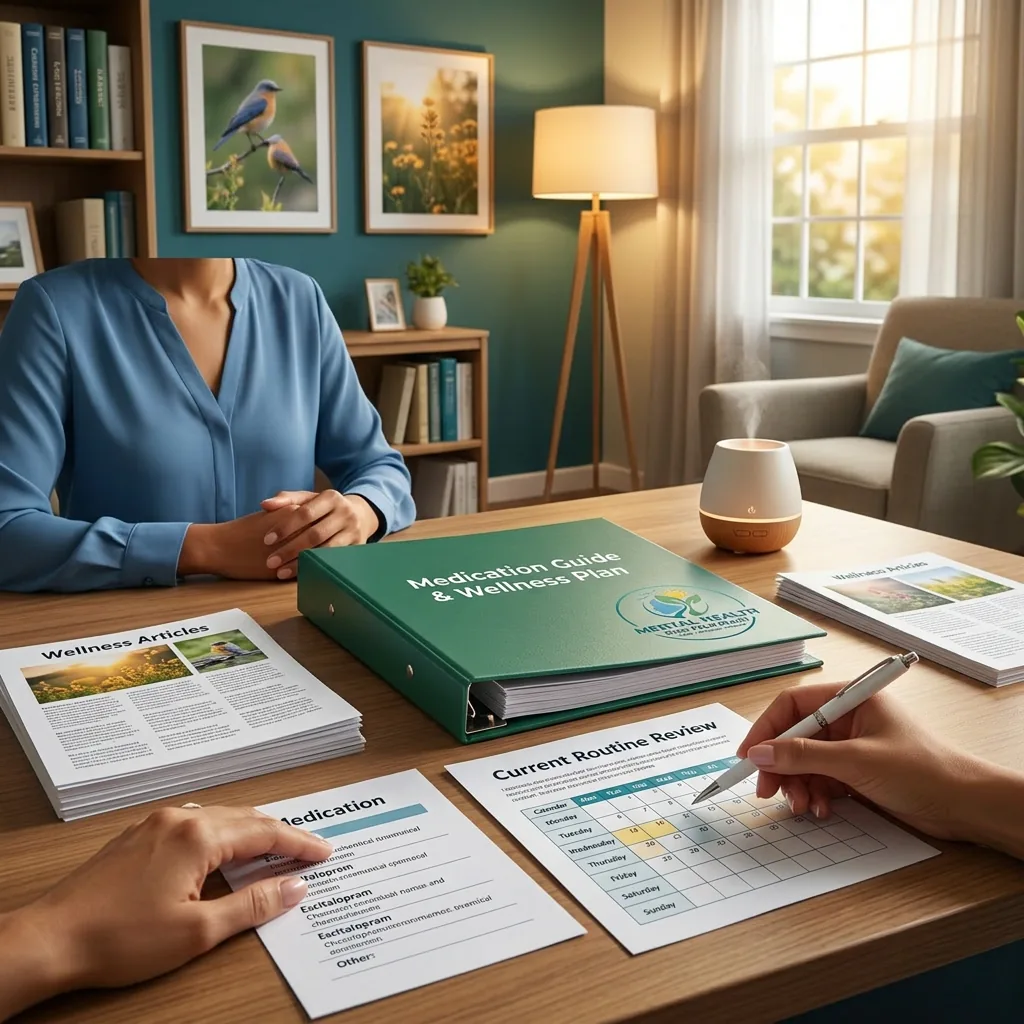
A personalized anxiety treatment plan can combine these strategies with professional guidance.
Evidence-Based Techniques That Work
Controlled Breathing: The Fastest Physiological Reset
The most reliably documented physiological intervention for acute anxiety is controlled diaphragmatic breathing with an extended exhale. Here is the mechanism: slow exhalation activates the parasympathetic nervous system via the vagus nerve, directly counteracting the fight-or-flight activation that produces anxiety symptoms. The exhale is the active ingredient — it is longer than the inhale that does the work. For more on this, see our guide to managing ADHD without medication.
The technique: inhale slowly for 4 counts through the nose, exhale slowly for 6–8 counts through the mouth. Practice it when you are calm so it is accessible when you are not.
Box breathing — 4 counts in, 4 hold, 4 out, 4 hold — is a well-established variant used in clinical and high-performance contexts. Both techniques work through the same vagal mechanism.
Progressive Muscle Relaxation (PMR)
PMR involves systematically tensing and releasing muscle groups throughout the body, producing physical relaxation that counteracts the somatic tension component of anxiety. Regular practice — 10–20 minutes several times per week — reduces baseline anxiety levels over time, not just acutely. Research supports PMR for generalized anxiety disorder, sleep-onset anxiety, and physical anxiety symptoms including headaches and muscle tension.
Exercise: Lower Your Anxiety Floor
Regular aerobic exercise is one of the most evidence-supported non-medication interventions for anxiety disorders. The mechanism is specific: exercise reduces cortisol and adrenaline levels over time, increases GABA activity (the inhibitory neurotransmitter that anti-anxiety medications target pharmacologically), and improves sleep quality — itself a major driver of anxiety severity.
The dose with consistent evidence: 30 minutes of moderate aerobic exercise most days of the week. This is not acute relief. It is a change in baseline anxiety level that accumulates over weeks of consistent practice. We cover managing bipolar disorder without medication in a separate article.
Limiting Caffeine
Caffeine is an adenosine antagonist and a stimulant that directly activates the sympathetic nervous system — the same system that produces anxiety symptoms. For people with anxiety disorders, caffeine reliably worsens symptoms, often mimicking or amplifying panic-like sensations: increased heart rate, muscle tension, alertness that tips into agitation.
Reducing or eliminating caffeine — particularly in the afternoon and evening — is not optional optimization for someone with clinically significant anxiety. It is a direct variable affecting symptom severity. If you currently drink multiple cups per day and have meaningful anxiety, cutting back is a high-yield change.
Sleep: The Anxiety Amplifier You Can Control
Sleep deprivation increases amygdala reactivity — the brain’s threat detection center — while simultaneously reducing prefrontal regulation. A single night of poor sleep measurably increases next-day anxiety. The deprivation-anxiety relationship is bidirectional: anxiety disrupts sleep, and poor sleep amplifies anxiety. Left unmanaged, this loop sustains itself.
Consistent sleep hygiene directly reduces daytime anxiety: fixed sleep and wake times, no screens before bed, and avoiding alcohol as a sleep aid. This is not a secondary concern for anxiety management — it is a front-line one.
CBT Techniques: Thought Records and Exposure
Cognitive Behavioral Therapy is the gold standard psychological treatment for anxiety disorders. Two core CBT tools are usable outside of sessions:
Thought records: When an anxious thought arises, write it down. Then challenge it with three questions: What is the evidence for this? What is the evidence against it? What would I tell a close friend thinking this? Writing the thought down externalizes it and engages the prefrontal cortex rather than the amygdala. This interrupts the automatic anxiety loop. If that applies to you, read more about managing depression without medication.
Behavioral exposure: Anxiety is maintained by avoidance — every time you sidestep a feared situation, you get short-term relief and long-term reinforcement of the fear. Graded exposure — approaching feared situations in a planned, stepwise way — is the mechanism through which CBT produces lasting change. This works best with a therapist guiding the hierarchy, but understanding the principle helps you move toward things rather than away from them.
Mindfulness and the 333 Method
Regular mindfulness practice — 10–20 minutes of sustained, non-judgmental present-moment attention — reduces anxiety by interrupting the anticipatory worry loops that fuel it. It changes neural patterns over time; it is not a one-session fix.
For acute moments, the 333 method is a well-established grounding technique: name 3 things you can see, identify 3 sounds you can hear, and move 3 parts of your body or identify 3 things you can physically feel. The mechanism is sensory-focused attention that redirects the nervous system from threat-anticipation to present-moment orientation. It will not resolve anxiety disorder — but it is a reliable circuit breaker when anxiety spikes.
When Anxiety Needs Professional Attention
Non-medication strategies have real limits. Schedule a professional evaluation when:
Panic attacks are occurring. Panic disorder — recurrent, unexpected panic attacks with escalating fear of future attacks — responds well to both medication and CBT, but untreated panic disorder tends to worsen through anticipatory avoidance and behavioral restriction. Our team also explains fast anxiety breathing techniques in detail.
Anxiety is interfering with daily life. If you are avoiding work situations, social events, driving, medical appointments, or other normal activities because of anxiety, the condition is running your decisions. This level of impairment warrants treatment, not management.
Generalized anxiety produces constant, uncontrollable worry. GAD involves excessive worry across multiple domains — health, finances, work, relationships — that the person cannot stop or redirect, accompanied by physical symptoms. Lifestyle strategies help but rarely resolve GAD fully without structured treatment.
PTSD or trauma is the underlying driver. PTSD involves a specific neurobiological response to traumatic events and requires trauma-focused treatment — EMDR, CPT, or Prolonged Exposure — not general anxiety management strategies.
Anxiety and depression are co-occurring. Comorbid anxiety and depression is the most common clinical presentation and is most efficiently addressed with combined professional intervention.
At Trust Psychiatry, anxiety treatment is provided by Josie Desmarais, PMHNP-BC. Josie evaluates adults for anxiety disorders throughout Florida, provides medication management when indicated — SSRIs and SNRIs are first-line for most anxiety disorders — and helps you determine the right level of care. Appointments are available in-person in West Palm Beach and via telehealth statewide.
Frequently Asked Questions
Can anxiety go away without medication?
For many people, yes. Mild-to-moderate anxiety often responds well to CBT, consistent exercise, sleep hygiene, and breathing techniques. Anxiety disorders with more severe symptoms — particularly panic disorder or GAD — typically respond better and faster when medication is part of the plan. A professional evaluation helps identify which approach is right for your situation. Learn more about the physical symptoms of anxiety here.
What is the best breathing exercise for anxiety?
Extended-exhale breathing — inhaling for 4 counts and exhaling for 6–8 counts — is the most consistently evidence-supported acute technique. The longer exhale directly activates the parasympathetic nervous system via the vagus nerve. Box breathing (4-4-4-4) is a widely used variant with the same mechanism.
What is the 333 rule for anxiety?
The 333 method is a grounding technique: identify 3 things you can see, 3 sounds you can hear, and 3 things you can physically feel or 3 body parts you can move. It works by shifting attention from anxious anticipation to present-moment sensory experience, interrupting the physiological anxiety response acutely.
Does caffeine worsen anxiety?
Yes, reliably. Caffeine stimulates the sympathetic nervous system and produces many of the same physiological sensations as anxiety — elevated heart rate, alertness, muscle tension, jitteriness. For people with anxiety disorders, reducing or eliminating caffeine consistently reduces symptom burden.
When should I consider medication for anxiety?
Medication is worth discussing when anxiety is causing significant functional impairment, when panic attacks are occurring, when anxiety has persisted for months despite consistent lifestyle effort, or when it is causing you to avoid important parts of your life. SSRIs and SNRIs are well-tolerated first-line options for most anxiety disorders. The right time is when anxiety is running your life — not when you have exhausted every other option. You may also want to understand the link between anxiety and hair loss.
Anxiety Treatment in West Palm Beach and Across Florida
Anxiety is highly treatable — and professional support significantly accelerates recovery compared to managing it alone. If your anxiety is affecting your work, relationships, or daily functioning, you do not have to wait until it gets worse to reach out. Schedule an anxiety consultation with Josie Desmarais, PMHNP-BC.
Available in-person in West Palm Beach or via telehealth statewide. Call (561) 849-4449 or contact us to get started.
Ready to Schedule a Psychiatric Evaluation?

Reviewed by · Board-Certified Psychiatric-Mental Health Nurse Practitioner
Josie Desmarais is a board-certified psychiatric-mental health nurse practitioner (PMHNP-BC) at Trust Psychiatry – Mental Health West Palm Beach. She provides psychiatric evaluation and medication management, and helps patients understand how anxiety disorders are evaluated and treated, through secure telepsychiatry for adults across Florida.